Launched in early 2012, the Raspberry Pi is a simple, Linux-based computer designed to make programming cheap and accessible. Coming in $25 and $35 models, it uses modest components and SD card storage, with an HDMI connection and optional ethernet port. In its first year, one million Pis have been sold, both to educational institutions and to coding enthusiasts.
Google’s Coder project turns the Raspbery Pi into a mini app server

raspberry pi Hackers and educators love the Raspberry Pi, and at least a few people at Google do too. For a year, Google has provided funding to a UK program that trains teachers on how to use the small, inexpensive computers in classrooms. This week, Google introduced Coder, a free software download built by a team of Googlers in New York that turns the Raspberry Pi into a tiny server that can host basic web apps for those learning to code in HTML, CSS, and Javascript. Google says setting Coder up on the Raspberry Pi takes just ten minutes.
All you need to get started is a Raspberry Pi, of course, an SD card to store Coder, and a Wi-Fi connection. This being an open-sourced Google project, the software runs in the Chrome browser — what else would you expect? The entire code library is available on GitHub for experienced developers who want to edit to the software itself, rather than just use it to build stuff. Google says it built Coder to be used in programming projects from groups such as Codeacademy and Khan Academy. The software even includes a few web apps that users can get things started with, such as an eyeball that is animated to blink.
Read Article >Cut-down ‘Minecraft’ released on Raspberry Pi for free

minecraft pi edition Mojang has released a version of their smash hit world-building game Minecraft for the tiny, inexpensive Raspberry Pi computer. Minecraft: Pi Edition is based on Pocket Edition, the mobile version currently available on iOS and Android, and you can download it now for free.
In common with the $35 Raspberry Pi’s stated goals of providing a low-cost way to get people into programming, Mojang hopes that players will use Pi Edition to “break open the code.” There’s support for multiple languages, and the idea is that “you’ll be learning skills through Minecraft.” The team has set up a dedicated Pi Edition website at pi.minecraft.net where you can download the game and find out how to get started.
Read Article >XBMC 12 ‘Frodo’ now available: adds Raspberry Pi and ‘initial’ Android support

XBMC 12 announcement Today there’s some good news for XBMC fans as version 12 of the popular open-source home media center software, codenamed ‘Frodo,’ has been officially released. The new version has a number of new features and improvements including Live TV and PVR support, which allows you to watch Live TV, listen to radio, and access a TV guide. The update also includes a new audio engine that provides access to a variety of HD audio standards including DTS-MA and Dolby True-HD. Theres good news for AirPlay users as well, as the new version of XBMC comes with improved support for Apple’s wireless standard, including the addition of AirPlay audio streaming for Windows users.
A major new feature coming with the update is official support for the $35 Raspberry Pi micro computer. The Raspberry Pi has the potential to be an excellent entry-level media streamer as the newer “Model B” now supports 1080p video. Frodo also includes “initial” support for Android which, unlike the XBMC Remote app, includes the full range of XBMC features and support for most devices.
Read Article >The BeetBox makes music with actual beets

beetbox FLICK We’ve seen a banana piano and a beer can keyboard, but what about beatboxing with an actual box of beets? For his final project in a technology crafting course, student Scott Garner has created a way to do just that. The cheekily dubbed BeetBox is powered by a Raspberry Pi, and uses an audio amplifier to play drum sounds based on input from a capacitive touch sensor. Put simply, touch beets, get beats. The whole system is encased in a simplistic, handmade wooden enclosure, which gives the BeetBox a clean, sophisticated look uncommon in many homebrew Raspberry Pi hacks. You can check out the cleverly designed instrument in action below.
Read Article >Raspberry Pi launches its very own app store

Pi Store Universally compatible beercan keyboard created using Raspberry Pi and Arduino

beer keyboard Robofun Create has built a fully functional keyboard using Staropramen beer cans, demonstrating once more that the potential of systems like the Arduino and Raspberry Pi is only limited by the creativity of those who use them. The keyboard — which would be an instant hit at pretty much any party — is made of 40 beer cans connected to an Arduino-powered touch controller attached to a Raspberry Pi that controlled the television display. Robofun Create designed the keyboard as part of the 2012 Webstock contest, and attendees could use it to input their email address to win a trip to Prague. It can be plugged into any computer, and while the keyboard isn’t quite as silly as a banana piano, it’s definitely one of the more unique ways to make use of empty beer cans.
Read Article >Learn to build a Raspberry Pi operating system, courtesy of Cambridge University

raspberry pi The $25 or $35 Raspberry Pi computer is a favorite of coders, who’ve turned it into a synth and embedded it in a camera grip among other things. Now, the Pi is getting attention from the University of Cambridge Computer Lab. Alex Chadwick, one of a group of students working with Pis at Cambridge over the summer, has published a guide to coding basic operating systems for the computer. “Baking Pi” is meant to help incoming freshmen get familiar with basic computer science before starting school, but it’s freely available to everyone.
Since the university is also purchasing a Pi for every freshman in the department, it’s published a series of these tutorials that are placed alongside more general material. Though it’s meant for people with some coding experience, it’s possible to follow the 12-part operating system guide without much prior knowledge, and it’s a perfect example of how the Pi’s creator hopes to get people interested in coding, this time from a major university.
Read Article >Watch this: the $25 Raspberry Pi turns into a synth

Raspberry Pi Synth There seems to be no shortage of uses for the credit card-sized Raspberry Pi, whether it’s running Android, being hooked up to your DSLR, or stuffed inside its spiritual forebear, the Commodore 64. Now one hardware project is looking to add “synth” to the customizable $25 microcomputer’s rapidly-expanding repertoire.
Read Article >Photographer embeds Raspberry Pi computer in DSLR battery grip

Raspberry Pi in camera grip Irish photographer David Hunt has managed to fit a Raspberry Pi — the card-sized device designed to promote computer science in schools — inside a standard Canon 5D Mark II battery grip, using the tiny Linux-based computer to transfer photos to his iPad. According to an explanatory blog post, the Pi runs a Perl script which constantly queries the camera for images — when it finds new shots, it grabs them and transfers them to the iPad’s Shuttersnitch app over the internet.
In the video demonstration below, Hunt’s creation relies on an Ethernet connection for internet access, but attaching a Wi-Fi dongle shouldn’t present any problems. Other possible uses for the device include backing up photos to a USB stick or an external hard drive and full remote control. In an update to his post yesterday, Hunt explains that he’s managed to enable triggering via the shutter release port, allowing him to take photos and wake the camera from sleep.
Read Article >Raspberry Pi runs ported version of Mozilla’s web-based Firefox OS

Firefox OS on Raspberry Pi While smartphones running Mozilla’s web-based Firefox OS aren’t expected to ship until 2013, that hasn’t stopped enthusiasts from porting the open source operating system to other platforms. The latest device to get a version of the system — formerly known as Boot to Gecko — is the Raspberry Pi, the $25 card-sized computer designed to promote computer science in schools.
In the video below, developer Oleg Romashin demonstrates the device performing some basic functions such as swiping through the OS’s menu. It doesn’t look like a particularly smooth experience, but, then again, the Pi only contains a relatively meager 700MHz CPU and 256MB of RAM, shared between the CPU and its Broadcom GPU. Mercifully, the latter seems more than capable of handling hardware-accelerated 3D graphics using WebGL, just as it performs well playing high-definition video.
Read Article >Raspberry Pi creator Eben Upton on how and why to get kids coding

raspberry pi The Linux-based Raspberry Pi computer is tiny, cheap, and very popular. But while plenty of adults adore the $35 device, designer Eben Upton hopes it will also spark a new wave of interest in programming for children. In an interview with Wired, Upton discusses his own experience with programming and what he sees as the failure of current computer education programs and “intuitive” computers. Earlier machines, he says, “were programmable. When you first turned them on, they booted into Basic and before loading a program, you had to program them. That meant that quite a lot of us were beguiled into learning to program, and I think that’s where my generation of hobbyist programmers came from.”
He’s had similar success taking the Raspberry Pi into classrooms and getting kids to work with games like Snake, where “by the end of the session, you have to pry the boards out of the children’s hands.” Go through and read the whole thing for more about computer education and why everyone should learn to code.
Read Article >Android 4.0 ported to Raspberry Pi, supports HD video but not audio

Android 4.0 on Raspberry Pi A working version of Android 4.0 Ice Cream Sandwich has been ported to the credit card-sized Raspberry Pi computer, allowing the $25 device to perform many of the functions of a modern smartphone or tablet, albeit at a somewhat slower pace. According to a post on the project’s official blog, the build supports hardware-accelerated video and graphics, but is not yet able to play sound due to problems with porting Android’s AudioFlinger system.
As Eurogamer points out, it’s not the first attempt to get Android up and running on the device — the Raspberry Pi community has been working on ports of CyanogenMod 7.2 (based on Android 2.3) and CyanogenMod 9 (based on Android 4.0) for some time. Still, it’s the first time the mobile operating system has been anywhere close to usable for everyday tasks, providing a real alternative to the various stripped-down Linux distributions currently available for the Pi platform.
Read Article >Raspberry Pi ramps up production, lifts purchase limit

raspberry pi Since going on sale in February, the miniature Linux computer known as the Raspberry Pi has had a very specific limitation — namely, orders were limited to one per customer due to demand. As of today, that’s all over — users can order as many of the tiny machines as they’d like. The change is driven to an increase in production capacity: according to a recent blog post, 4,000 units of the “model B” Pi are being manufactured every single day. That’s not to say the device will be shipping immediately — new orders are currently projected to arrive in September — but the policy change will no doubt be welcome news for those anxious to get their hands on the credit card-sized computer.
Read Article >SNES and BBC Micro revived by Raspberry Pi modders

snes raspberry pi While the fact that the Raspberry Pi ships without a case might be off-putting to some, it’s a clear boon to those with the ability to make the most out of the tiny Linux machine. It’s not a surprise, then, that we’re starting to see some innovative ways to leverage the hardware, starting with this Super Nintendo mod from Florian of petRockBlog. The mod involves a PCB that acts as a hardware interface for a SNES emulator, so you can play Super Mario Kart with the same controller you practiced your time trials on back in 1992.
Meanwhile, modder Ben Heck has been working on something from even further back — a full-on wooden BBC Micro-style case for the Raspberry Pi that gives the computer a keyboard, power switch, I/O ports and even expandability through a cartridge slot. The mod is yet to be fully revealed, but it’ll be featured in the next episode of the Ben Heck Show. Until then, you’ll have to make do with the trailer below.
Read Article >FishPi is a tiny, Raspberry Pi-enabled ship that aims to cross the Atlantic

FishPi Now that Raspberry Pi’s are getting into the hands of folks around the world, we’re starting to see all kinds of interesting projects. And in the case of Greg Holloway, his goal is a little more ambitious than most — to use a Raspberry Pi to create an autonomous vehicle that will cross the Atlantic Ocean. The aptly named FishPi project is currently in the proof of concept phase, but the final version will be powered by a 130 watt solar panel and includes features like a GPS, servo controller board for driving the rudder and motor, a compass, and a camera. The current test version is 20-inches long and features the Raspberry Pi itself housed in a plastic sandwich container. There’s no word yet on when the FishPi will be ready to take to the seas, but eventually Holloway hopes to create kits so that students and hobbyists can easily create their own autonomous water vehicles.
Thanks, Coolius!
Read Article >Motorola’s LapDock hacked back to life using Raspberry Pi and Rikomagic computers
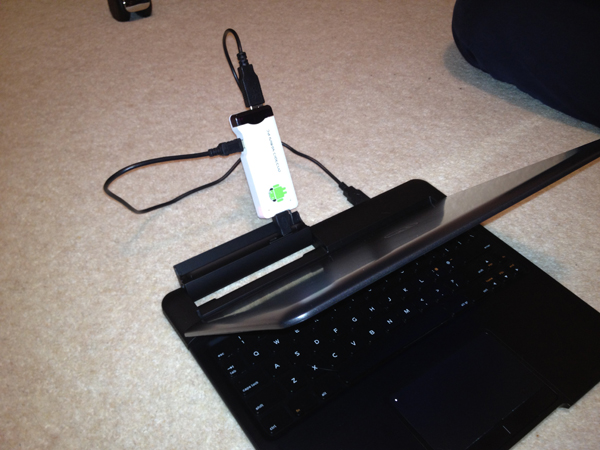
Luckily, the Rikomagic is actually available for sale, and some people will prefer its Android 4.0 OS and tidy exterior casing. It costs a bit more than twice as much as the Raspberry Pi, but the Rikomagic is also about twice as powerful — it has a 1.5GHz single-core processor with 512MB of RAM and a Mali 400 GPU. The MK802 also includes Wi-Fi connectivity, making it a little more user-friendly than the Ethernet-only Raspberry Pi. The MK802’s only real downside is that it only outputs in 1080p and 720p, meaning the picture will be slightly smaller than the LapDock’s native 1336x768 LCD.
So, if you’re one of the people who jumped at the potential of Motorola’s first run of WebTop products, take heart — modders don’t know the meaning of the word “discontinue.”
Read Article >Google to provide Raspberry Pis and Arduinos, train teachers for UK schools

Raspberry Pi Google has announced a three-year partnership with UK organization Teach First, which aims to increase students’ exposure to science and technology by training teachers and providing equipment. Each year 34 teachers will go through a six-week training program, for a total of 102, with the first group due to start working in classrooms this September. Google executive chairman Eric Schmidt believes that the program could help more than 20,000 students from underprivileged backgrounds. The teachers will be provided funds to “purchase of innovative teaching aides to inspire their classes,” including the Raspberry Pi computer and Arduino microcontroller. “The success of the BBC Micro in the 1980s shows what’s possible,” said Schmidt. “There’s no reason why Raspberry Pi shouldn’t have the same impact, with the right support.”
Read Article >First Raspberry Pi orders now shipping worldwide

raspberry pi After a number of delays, the first batch of the Raspberry Pi has reached its distributors and the tiny computer board should begin shipping to customers very soon — in fact, in some cases it looks like buyers have already received theirs. The current shipments are being sent out to those who were quick enough to grab one of the first batch before it sold out, and distributor RS Components says that it’s working closely with the manufacturer to bring additional shipments in stock to help clear out the order backlog. The launch of the Pi — a $35, credit card-sized, Linux-based computer — has been delayed a few times, due both to manufacturing problems and issues with compliance testing. If you still want to pick one up, the tiny machines can be ordered from both RS Components and Allied Electronics.
Read Article >Raspberry Pi completes CE compliance testing, clears the way for UK sales to resume

raspberry pi The introduction of the Raspberry Pi hasn’t been without its hiccups: the initial batch sold out near-instantaneously, and further production was then held up due to the Raspberry Pi Foundation’s manufacturing partner sourcing the wrong type of ethernet jacks. The latest speedbump was due to the miniature computer not having undergone proper CE compliance testing — but it appears that hurdle has been cleared. In a post on its blog, the foundation reports that after a week of evaluation, the Raspberry Pi has passed the required electromagnetic compatibility testing, with no changes to the hardware required. The foundation also ensured that the device passed muster with the FCC, as well as Canadian and Australian regulatory agencies. Paperwork will still need to be processed before the two UK distributors that had balked at the certification-free version of the device will resume sales, but it should be just a matter of time before the miniature machine begins flowing freely into consumer’s hands once again.
Read Article >Raspberry Pi UK distribution delayed by the need for ‘CE mark’ testing and compliance

Raspberry Pi A few weeks after opening pre-orders and beginning production of the tiny Raspberry Pi Linux computer, its developers have announced that two of its UK retail partners are unwilling to distribute the device without the CE marking. This mark is fairly ubiquitous on consumer electronics products and indicates that the manufacturer is complying with Europe’s regulations and that the product can be sold throughout the Europe Economic area. This comes a few days after the Raspberry Pi team declared that they weren’t having their devices tested for electromagnetic compatibility, a key part of getting the CE mark. The team declined to seek the CE mark because it believes Raspberry Pi is not a “finished end product” and thus doesn’t need it, but apparently its retail partners think otherwise.
However, the team is now working quickly to get the 2,000 Raspberry Pi devices that were just delivered to the UK certified as quickly as possible by having the aforementioned EMC tests performed. Raspberry Pi’s developers are also working with the Department for Business, Innovation, and Skills to determine once and for all if the computer in fact requires the CE marking. Either way, the boards will hopefully be shipping soon, but the team can’t say exactly when yet.
Read Article >The Pirate Bay wants to use flying drones to operate over international waters

The Pirate Bay USB Key While The Pirate Bay’s founders lost their appeals against their sentences in Sweden recently, the torrent site claims to have some unique ideas about how to operate going forward. A blog post reveals plans to host some of the site’s machines on drones that will “float some kilometers in the air,” necessitating “a real act of war” for anyone wanting to take them down. Furthermore, The Pirate Bay tells TorrentFreak that it’s planning to fly the first drone in international waters, which would further muddy the waters surrounding which jurisdictions the site can be accused of breaking the law in.
Of course, this sounds like a pretty crazy plan on paper, and The Pirate Bay admits it still hasn’t “figured everything out yet.” Still, the idea simply being theoretically possible is intriguing, with tiny computers like the Raspberry Pi and inexpensive radio equipment apparently helping The Pirate Bay serve up over 100Mbps per node over 50 kilometers away. We’ll believe it when we see it, but one thing’s for sure — the team behind one of the internet’s most notorious sites will try anything to keep itself alive.
Read Article >Raspberry Pi suffers a minor production setback

raspberry pi ethernet jack Just as the Raspberry Pi went into production and sold out of its initial batch, there’s been a slight hitch in the plans. A sourcing glitch from the manufacturer meant that Ethernet jacks without integrated magnetics were soldered to the board, leaving the tiny computers without network connectivity. As you can see from the photo above, it’s not a difficult mistake to make (the color doesn’t have anything to do with it). Fortunately, the problem simply requires desoldering of the old jacks and substituting in the new part, but finding a sufficient amount may be an issue with the next batch. The team is trying to source as many as they can in order to get the production line back up and running, and the factory has nearly finished replacing parts on the first batch.
While the delay is disappointing, we have to applaud the Raspberry Pi Foundation’s transparency throughout the whole process — ever since the project was announced, we’ve been kept up to date with the minutiae of manufacturing each step of the way. Larger companies would do well to keep their customers similarly in the loop.
Read Article >Raspberry Pi $35 miniature computer now on sale, $25 model going into production ‘immediately’

raspberry pi We knew the Raspberry Pi, the diminutive, low-cost Linux-based computer, would be available for order at any moment, and today the Raspberry Pi Foundation has announced on its website that the tiny machines are on sale. The Raspberry Pi comes in two different variants: the $25 Model A runs a 700MHz ARM processor with 256MB of RAM, HDMI and RCA video outputs, and SD card storage. The $35 Model B adds two USB ports and one ethernet port to the mix. The first units that have been produced are of the Model B variety, but production on the Model A version is said to be beginning immediately. Sales are limited to one per customer, and are available through Premier Farnell and RS Components.
Read Article >Raspberry Pi: first batch to be finished February 20th, on sale by end of the month

raspberry pi Production started on the $35 Raspberry Pi last month, and now the team has announced that after a slight delay related to sourcing a component, the first manufacturing run will be finished on February 20th. What does this mean for you? Since the batch of tiny Linux machines will be airfreighted to the UK as soon as they leave the factory, you should be able to put down your $35 for one by the end of the month. The initial production run of 10,000 units has been focused on the higher-end configuration, with a $25 model that halves the memory and omits the Ethernet controller due for sale at a later date.
Read Article >Raspberry Pi demonstrated running XBMC and AirPlay

raspberry pi While the primary goal of the Raspberry Pi is to get inexpensive ($25-$35), programmable computers into the hands of people everywhere, it also looks pretty handy as an HTPC. We reported a while back that it’s capable of 1080p playback over HDMI, and we’re now seeing that capability put into practice — namely, with support for XBMC and AirPlay wireless streaming. XBMC is open-source media center software that was first developed for the original Xbox, and the tiny computer can use it to output 1080p video via the OpenMax API. Also demonstrated was an AirPlay application, with a YouTube video streaming smoothly from an iPad to a TV after a few seconds’ delay. Production started on the Raspberry Pi a couple of weeks ago, so you should be able to get your hands on one relatively soon.
Read Article >


Most Popular
Most Popular